You asked customers the famous question — "how likely are you to recommend us, 0 to 10?" — and now you're staring at a number wondering whether to celebrate or panic. Here's how to read it.
How the math works
Net Promoter Score sorts every response into three buckets. Customers who answer 9 or 10 are promoters — genuine fans. Those who answer 7 or 8 are passives — satisfied, but not excited enough to talk about you. Anyone from 0 to 6 is a detractor — someone whose experience fell short.
Your score is the percentage of promoters minus the percentage of detractors. Passives count toward the total but neither help nor hurt. That means NPS runs from −100 (everyone is a detractor) to +100 (everyone is a promoter), and a score of zero means fans and critics are exactly balanced.
The benchmarks
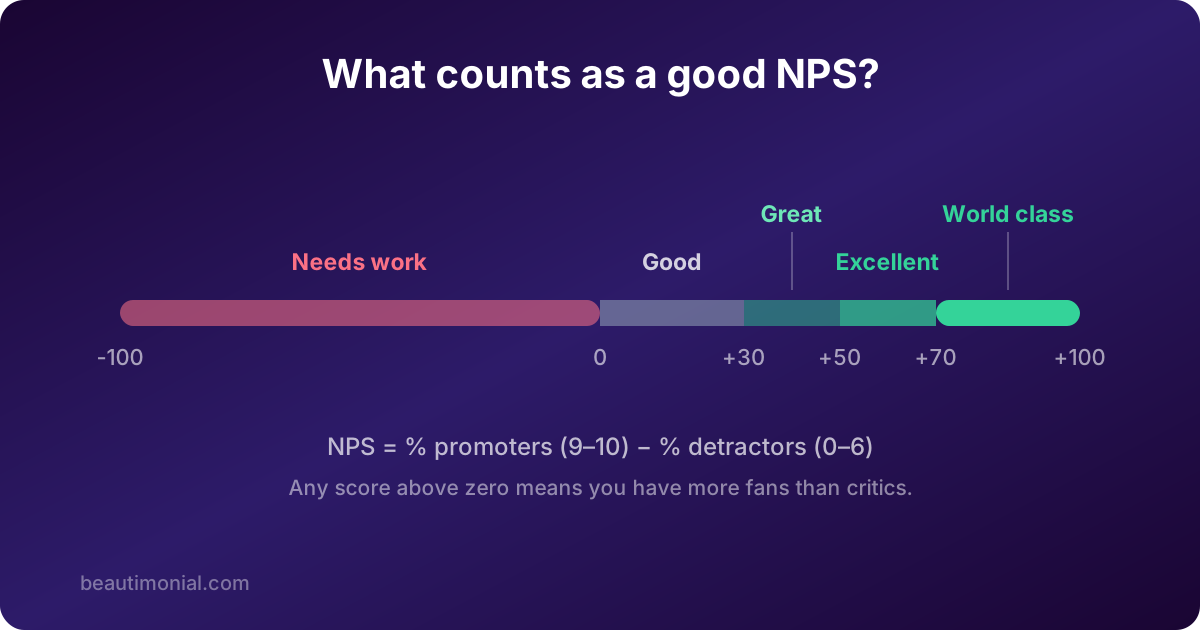
- Above 0 — good. More fans than critics; most businesses never reliably clear this bar.
- Above 30 — great. A clear majority of customers are actively positive.
- Above 50 — excellent. Word of mouth is doing real work for you.
- Above 70 — world class. Rarefied territory occupied by the most loved brands.
Averages vary a lot by industry — subscription software tends to sit higher than airlines or telecoms — so comparing yourself to a global average is less useful than comparing yourself to your own score last quarter. The trend is the signal; the snapshot is just a starting point.
A warning about small numbers
If you've collected twelve responses, one grumpy customer swings your score by eight points. Say ten of the twelve are promoters and two are detractors: that's an NPS of +67. One more detractor and you're at +54 — a thirteen-point drop from a single unhappy reply. Early on, expect your NPS to bounce around; that's arithmetic, not a crisis. Keep collecting, watch the three-month trend, and resist redesigning your product over a single bad week.
NPS or star ratings?
Both, but for different jobs. Star ratings live next to individual testimonials and help visitors judge a product at a glance. NPS is an internal instrument: it measures the relationship, catches unhappy customers before they churn, and tells you which customers to ask for public praise. Stars face your buyers; NPS faces you.
How to actually improve it
The score itself is a thermometer. Improving it means treating the two ends of the scale completely differently.
- Close the loop with detractors — fast. A 0–6 score is a customer telling you exactly where it hurts, privately, before they say it publicly. Read every message, reply personally, and fix the repeat offenders. Detractors who get a real response often become your most loyal customers.
- Ask at the right moment. Survey people right after a win — an order delivered, a project finished — not months later when the memory has faded into a shrug.
- Put promoters to work. A 9 or 10 is a raised hand saying "I'd recommend you." That is precisely the moment to ask for a public testimonial, while the enthusiasm is real and present.
- Watch the passives. 7s and 8s are one good experience away from becoming promoters — and one bad one from becoming detractors. Small product and support improvements move this group most.
Make it automatic
The teams that get value from NPS aren't the ones with the fanciest dashboards — they're the ones who measure continuously and route each response to the right place. That's how Beautimonial's smart NPS routing works: every customer picks a score first; promoters flow into the public testimonial flow, detractors go to a private feedback form only you read, and your dashboard tracks the score, the distribution, and the monthly trend. Praise goes public. Problems come to you. The number takes care of itself.